AI Agent vs Chatbot
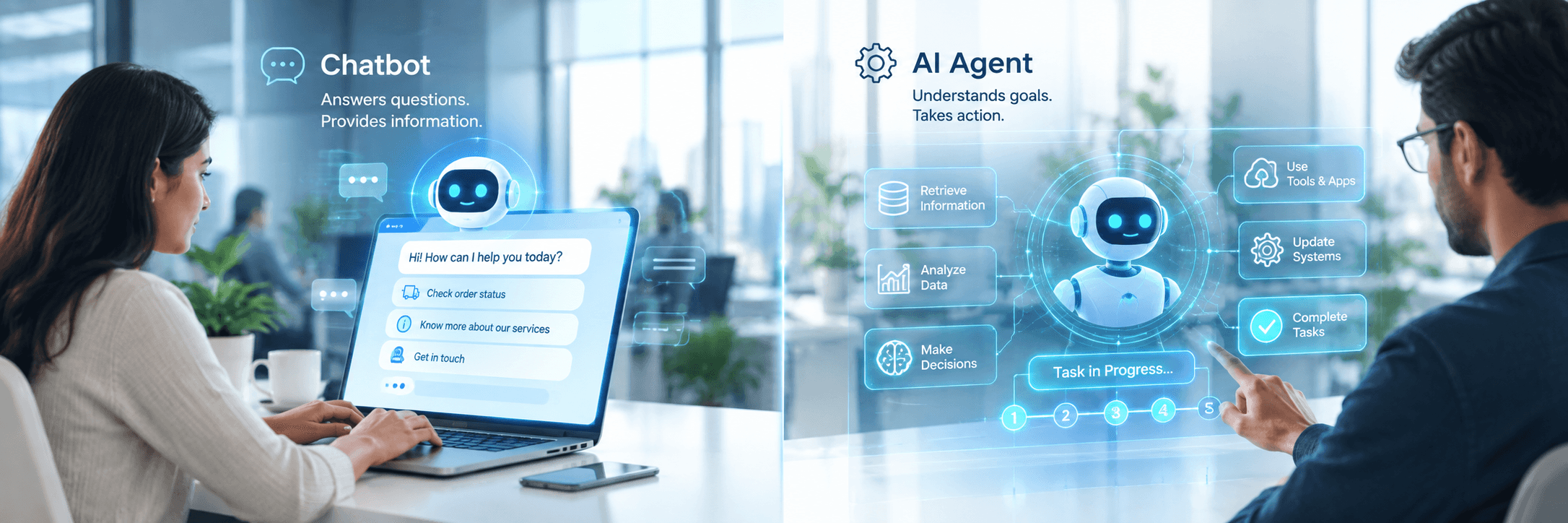
AI is transforming customer engagement, information management, and automation within businesses. In view of this growing adoption, phrases like “AI chatbot,” “AI assistant,” “conversational AI,” “AI agent,” and others are frequently used interchangeably, when, in reality, they have distinct meanings. Though chatbots and AI agents both have the capability to understand natural language and interact with the user, they differ greatly in terms of what they can do and why they exist. A chatbot tends to be focused on answering questions and enabling conversation, while an AI agent may be programmed to understand objectives, make decisions, utilize tools, and perform multiple steps of actions. Thus, knowing the distinction between AI Agent vs Chatbot may prove useful for choosing a proper solution.
What Is an AI Chatbot?
An AI chatbot is a computer program that makes it possible for humans to converse with an organization in a natural language form. In other words, customers do not have to wait for the employee to answer each and every standard question but instead can interact with the chatbot and get their information right away. Today's AI chatbots are able to understand various types of questions, understand conversation context, give the right answer, gather the necessary information, and help the user get to the next stage. Businesses often employ chatbots for customer support, FAQ questions, lead generation, service information, websites support, appointments questions, and troubleshooting.
What Is an AI Agent?
The AI Agent is created to do more than just converse with the users and help to achieve certain objectives. Depending on how the AI agent is created, it can comprehend the request, evaluate the available data, define what should be done, communicate with the connected programs or applications and undertake authorized actions. Unlike the traditional approach of answering the user’s question, the AI Agent may potentially work further and undertake all steps needed to reach the goal. Such an agent can be integrated into various business applications, databases, CRM systems, knowledge management tools, communication means and other programs making the AI a part of the real business processes rather than just a communication interface.
Take for example a client who wants to change his appointment. The chatbot may inform him about the procedure or offer the link to the scheduling service. The AI Agent integrated into the necessary systems may potentially identify the customer, find available time periods, suggest suitable options, update the appointment based on the authorization and inform the customer about it. This is not only the issue of how “smart” the system is. This is the issue of being able to take actions during the process.
AI Agent vs Chatbot: The Core Difference
|
Comparison |
AI Chatbot |
AI Agent |
|
Primary Focus |
Conversation-oriented and designed to communicate with users. |
Task and outcome-oriented, designed to achieve a specific objective. |
|
Main Function |
Answers questions, explains services, and collects customer information. |
Retrieves information, evaluates situations, makes decisions, and performs actions. |
|
Interaction |
Generally responds when a user asks a question or starts a conversation. |
Can work toward a broader objective that requires multiple steps. |
|
Workflow |
Usually handles individual conversations or requests. |
Can coordinate multiple steps within a business workflow. |
|
Decision-Making |
Typically has limited decision-making within its defined flow. |
Can make decisions within defined rules and business boundaries. |
|
System Interaction |
May have limited integrations with business systems. |
Can potentially interact with connected systems, applications, and databases. |
|
Example |
Answers an order-status question. |
Checks an order, evaluates the situation, takes an authorized action, and updates the customer. |
|
Nature |
Primarily reactive. |
Can be designed to perform multi-step tasks toward an outcome. |
|
Requirements |
Mainly requires relevant knowledge and conversational capabilities. |
Requires integrations, permissions, data, rules, and appropriate safeguards. |
|
Key Difference |
Provides answers. |
Takes actions to accomplish tasks. |
When Should a Business Use a Chatbot?
-
Use a chatbot when the business primarily needs an efficient communication channel for customers, employees, or website visitors.
-
Handle repetitive questions about services, products, policies, processes, or general information.
-
Provide immediate assistance while reducing the workload on customer support teams.
-
Collect basic lead details from potential customers.
-
Guide visitors through common questions and requests.
-
Provide initial customer support before transferring complex issues to human representatives.
-
Choose a chatbot when communication is the main requirement and a larger automation system is unnecessary.
When Should a Business Use an AI Agent?
-
Use an AI agent when the main objective is to automate a process, rather than simply answer questions.
-
Automate repetitive tasks such as retrieving information, moving data between applications, and checking records.
-
Qualify requests and prepare responses based on available information.
-
Automate scheduling and follow-up activities within defined workflows.
-
Reduce repetitive manual work and allow employees to focus on tasks requiring judgment and expertise.
-
Support processes such as lead qualification, customer service, document processing, employee support, appointment management, reporting, and follow-ups.
-
Connect the AI agent with appropriate business systems to perform multiple steps within a defined workflow.
How Digicane Systems Can Help
As opposed to chatbot solutions that rely on conventional means of development, Digicane Systems specializes in developing AI technologies to help companies conduct their business operations. In particular, this company can develop such technologies as AI agents and enterprise automation, RAG and knowledge platforms, Voice AI, and Vision AI. All of these technologies can be used depending on particular business needs – whether one wants to improve the interaction with customers, automate the workflow, obtain access to business knowledge, deal with voice-based interaction, or use visual intelligence in business processes.
Conclusion
What makes the difference between an AI agent and a chatbot lies in purpose, capability, and actions. While chatbot is designed to interact and answer queries, an AI agent can be created to perform certain actions and reason through the process of completing the task.
As organizations move from basic AI conversations toward intelligent automation, understanding this distinction becomes increasingly important. Chatbots can improve communication and customer support, while AI agents can extend automation into complex business workflows. With the right architecture and implementation, businesses can use both technologies together to create AI systems that do more than answer questions—they can help organizations accomplish meaningful tasks and improve operational efficiency.